


Some Examples of Idioms Every English Speaker Should Know
Someone asks a friend to explain what an idiom actually is, and the friend struggles to describe it in the abstract, then suddenly says, “oh, like ‘it’s raining cats and dogs.'” That one small example does more work than any formal definition could, which is exactly why having some examples of idioms on hand matters so much when learning or explaining figurative language.
Idioms show up constantly in everyday English, conversations, TV, books, casual writing, yet defining the concept alone rarely helps someone actually recognize or use them. Concrete examples make the idea click almost instantly.
This matters for language learners building early vocabulary, teachers looking for a quick reference, and native speakers who want a refresher on some of the most common phrases they use without thinking twice.
Rather than an exhaustive, overwhelming list, this piece offers a clear, well-organized set of common idiom examples, each with a definition and sample sentence, so you can see exactly how they work in real context.
By the end of this piece, you’ll have a solid collection of idiom examples across common categories, ready to reference, study, or share.
What Are Some Examples of Idioms?
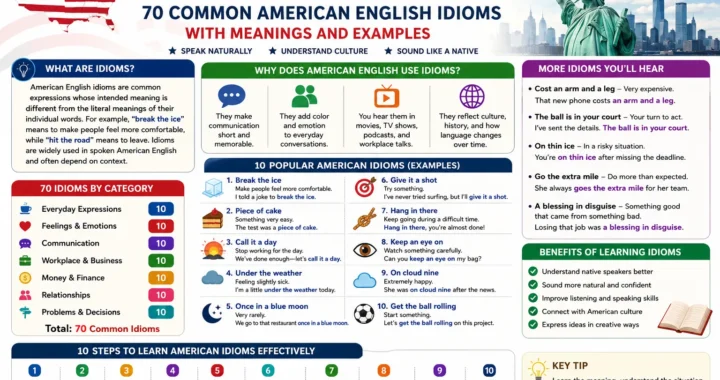
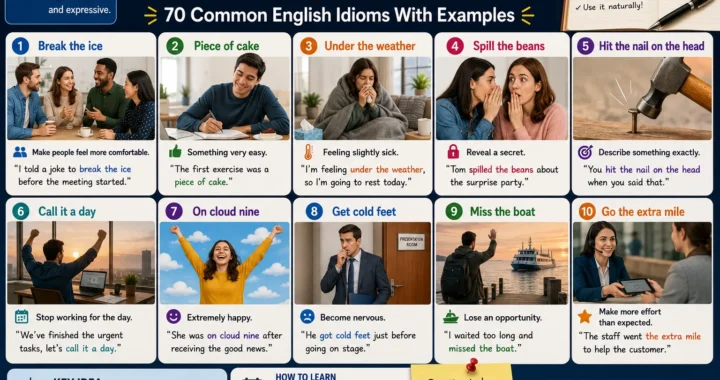
Some common examples of idioms include “piece of cake” (something very easy), “break the ice” (to ease social tension), “spill the beans” (to reveal a secret), and “under the weather” (feeling sick). Each of these phrases carries a meaning completely different from what the individual words suggest literally, which is the defining feature of any idiom.
Idiom Examples for Everyday Situations
- Piece of cake – Something very easy. “That test was a piece of cake.”
- Break the ice – To ease social tension. “He told a joke to break the ice.”
- Hit the sack – To go to sleep. “It’s late, I should hit the sack.”
- Spill the beans – To reveal a secret. “She spilled the beans about the surprise.”
- Call it a night – To stop an activity and go to bed. “We’re both tired, let’s call it a night.”
These are some of the most frequently used idioms in casual conversation, making them a natural starting point for anyone building idiom vocabulary.
Idiom Examples for Emotions
- Over the moon – Extremely happy. “She was over the moon about the acceptance letter.”
- Under the weather – Feeling sick. “I’m staying home; I’m under the weather.”
- Butterflies in my stomach – Feeling nervous. “I get butterflies before every interview.”
- Down in the dumps – Feeling sad or low. “He’s been down in the dumps all week.”
These idiom examples show how figurative language adds emotional color that plain adjectives often lack.
Idiom Examples for Time and Money
- Once in a blue moon – Something that happens very rarely. “We only meet up once in a blue moon.”
- In the nick of time – Just before it’s too late. “He arrived at the airport in the nick of time.”
- Cost an arm and a leg – Very expensive. “That laptop cost an arm and a leg.”
- Break the bank – To spend more than you can afford. “The trip didn’t break the bank.”
These examples appear frequently in both casual conversation and everyday writing about schedules or spending.
Idiom Examples Involving Animals
- Let the cat out of the bag – To accidentally reveal a secret. “He let the cat out of the bag about the party.”
- Kill two birds with one stone – To accomplish two things with one action. “Running errands on my way home kills two birds with one stone.”
- Hold your horses – Wait, slow down. “Hold your horses, we’re not ready yet.”
- When pigs fly – Something that will never happen. “He’ll clean his room when pigs fly.”
Idiom Examples for Work and Effort
- Hit the books – To study hard. “I need to hit the books before the exam.”
- Touch base – To make brief contact or follow up. “Let’s touch base tomorrow.”
- Bite the bullet – To face something difficult after avoiding it. “I finally bit the bullet and made the appointment.”
- Burn the midnight oil – To work late into the night. “She’s been burning the midnight oil to finish her thesis.”
Expert Insights: Why Concrete Examples Teach Idioms Better Than Definitions Alone
A dictionary-style definition of “idiom” explains the concept abstractly, but it rarely helps someone recognize or use an idiom confidently. Seeing several clear examples, each with a definition and sentence, builds a much stronger, more practical understanding.
This happens because idioms are learned through pattern recognition and repeated exposure, not through memorizing a formal rule. Once someone sees enough examples, they start to intuitively recognize the difference between literal and figurative language on their own.
Language teachers often introduce idioms this way specifically, starting with a handful of clear, common examples, before ever presenting a formal definition, since the examples do most of the conceptual heavy lifting.
This is part of why “some examples of idioms” is such a common, practical search: people usually learn this concept far better through direct examples than through abstract explanation.
Common Mistakes People Make With Idiom Examples
Mistake 1: Taking the idiom literally
New learners sometimes picture the exact words, leading to confusion. Idioms should be understood as a complete unit of meaning, not broken apart.
Mistake 2: Using an idiom without knowing its exact meaning
Choosing an idiom because it sounds familiar, without confirming its precise meaning, risks using it incorrectly.
Mistake 3: Overusing idioms in formal writing
Casual idioms like “spill the beans” can sound out of place in professional or academic writing.
Mistake 4: Forgetting to include a full example sentence
Learning just the phrase and definition, without seeing it in context, makes it harder to remember and use naturally later.
Practical Steps to Learn From These Idiom Examples
- Start with five idioms at a time, rather than trying to memorize a long list all at once.
- Read each idiom in its full example sentence, not just the isolated phrase.
- Write your own sentence using each new idiom to reinforce understanding.
- Notice these idioms in real conversations, shows, or reading, since repeated exposure builds retention.
- Review the list periodically, moving idioms from recognition into confident, natural use.
Idiom Examples at a Glance
| Idiom | Meaning |
|---|---|
| Piece of cake | Very easy |
| Break the ice | Ease social tension |
| Spill the beans | Reveal a secret |
| Over the moon | Extremely happy |
| Cost an arm and a leg | Very expensive |
| Bite the bullet | Face something difficult |
This table offers a quick-reference summary of the idiom examples covered throughout this piece.
Frequently Asked Questions
Q: What are some simple examples of idioms?
A: Common examples include “piece of cake” (something easy), “break the ice” (ease tension), “spill the beans” (reveal a secret), and “under the weather” (feeling sick). Each carries a meaning separate from its literal words.
Q: Why do idiom examples help more than a definition alone?
A: Examples show how idioms actually function in real sentences, making the figurative meaning concrete rather than abstract. Most people learn idioms faster through examples than through formal definitions.
Q: Are these idiom examples used in both American and British English?
A: Most examples in this list, like “piece of cake” and “spill the beans,” are widely understood across major English dialects, though some idioms do vary by region.
Q: Can I use these idioms in professional writing?
A: Some, like “touch base,” fit professional contexts well. Others, like “spill the beans” or “hit the sack,” are better suited for casual conversation rather than formal writing.
Q: How many idiom examples should I learn at once?
A: Starting with five to ten at a time, reviewed regularly, tends to build stronger retention than trying to memorize a large list all in one sitting.
Q: Do these idiom examples all follow the same grammatical pattern?
A: No. Some function as verb phrases (“spill the beans”), others as adjective phrases (“under the weather”), and others as noun phrases (“a piece of cake”), each behaving slightly differently within a sentence.
Q: Where can I find more idiom examples beyond this list?
A: Broader idiom collections organized by theme, region, or difficulty level offer more extensive references once you’re ready to expand beyond these common starting examples.
Bringing It All Together
Some examples of idioms go a long way toward making an abstract concept feel concrete and usable. Seeing phrases like “piece of cake” or “spill the beans” in real sentences does more to build understanding than any formal definition could on its own.
Starting with a manageable set of common, everyday idioms, then gradually expanding as they become familiar, builds genuine, lasting vocabulary rather than a pile of quickly forgotten phrases.
The next time someone asks you for an idiom example, you’ll have plenty ready to share, and a clear sense of exactly why each one works the way it does.
Read More: Pictures for Idioms: Visual Learning Guide


[…] Read More: Some Examples of Idioms with Meanings & Sentences […]